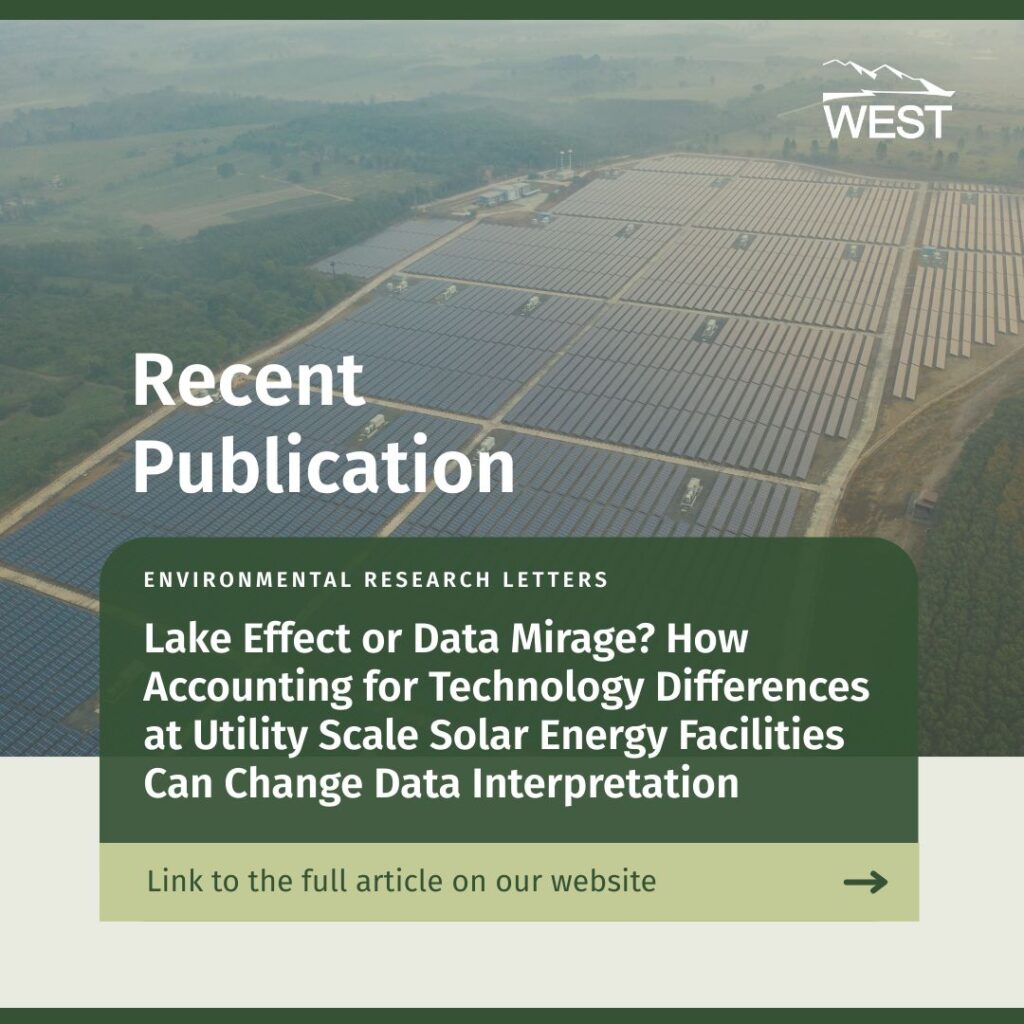
WEST Senior Statistician Daniel Riser-Espinoza is a co-author with Karl Kosciuch and Marisa Mitchell of the recently published research article, “Lake Effect or Data Mirage? How Accounting for Technology Differences at Utility Scale Solar Energy Facilities Can Change Data Interpretation,” in Environmental Research Letters.
The research dives into how differences in solar technology types (like fixed-tilt vs. single-axis tracker panels) can influence conclusions about bird mortality at large solar facilities and why this matters for wildlife impact assessments and policymaking. The paper highlights that much of the existing support for the “lake effect hypothesis” is based on datasets that don’t represent modern solar technology, and that careful technology-specific analysis is key for drawing appropriate inferences about the influence of any solar technology on birds.
“By looking at data through the lens of technology we were able to address common misconceptions and misinterpretations of avian fatality data from solar facilities. Data from a single facility using technology that no longer represents current development trends has had an outsized influence on the perception of avian risk from photovoltaic solar, and our analysis shows a lack of support for a generalized ‘lake effect’ phenomenon.” – Daniel
Read the full open-access publication here: https://lnkd.in/g2aJ4SGf