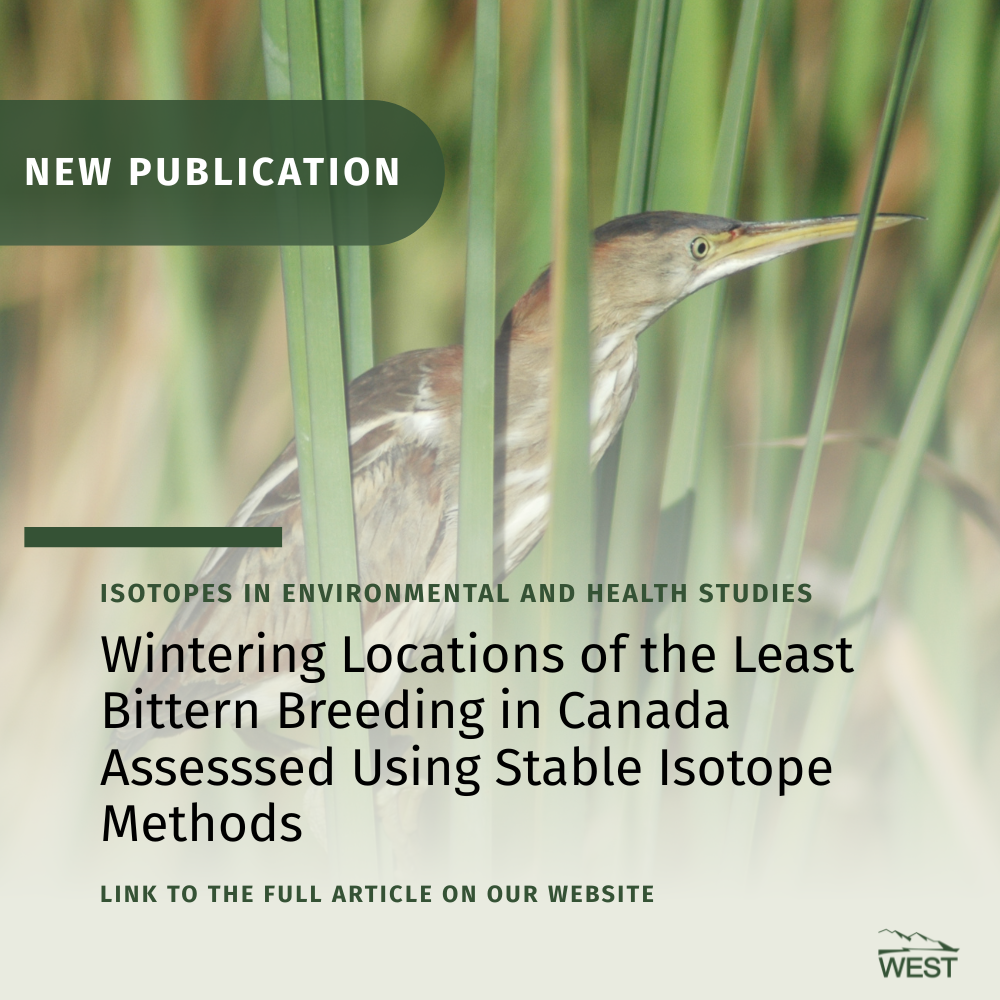
WEST Senior Wildlife Biologist Nick Bartok is a co-author on the recently published research article, “Wintering Locations of Least Bittern Breeding in Canada Assessed Using Stable Isotope Methods,” published in Isotopes in Environmental and Health Studies.
The least bittern (Botaurus exilis) is listed as threatened under Canada’s Species at Risk Act, but because of its secretive nature, little has been known about where these species go once they leave their Canadian breeding grounds.
This research explores hydrogen, carbon, and nitrogen isotopic compositions from body contour feathers collected from museum specimens spanning the species’ Canadian breeding range. Using assignment-to-origin algorithms, they identified the most likely wintering areas: Mexico, Central America along the Gulf Coast, and potentially coastal and Amazonian South America. These findings show implications for understanding population trends and guiding conservation efforts across the full annual cycle.
“As many of us know, writing manuscripts can take a long time and after 16 years of on-and-off work with various co-authors, we finally have a finished product. This research addressed a long-standing question about where least bitterns spend the winter. It was assumed they wintered along the Gulf Coast, and this research confirmed that is indeed the case but also showed they may travel even further, potentially as far as South America. Working on an isotope project was a steep learning curve for me, and I’m grateful to my co-authors who brought so much more expertise in this area.” – Nick Bartok