At this year’s American Clean Power Association (ACP) Siting and Permitting Conference, WEST staff shared applied research and real‑world case studies demonstrating how science‑based conservation strategies are shaping the future of renewable energy development. Across wind and solar projects nationwide, these sessions highlighted how innovative monitoring tools, targeted habitat management, and adaptive mitigation approaches are helping developers navigate evolving regulatory requirements while advancing biodiversity and conservation outcomes. From wildlife use of operational solar facilities to next‑generation bat conservation strategies and soil health improvements, WEST’s presentations underscored the value of data‑driven decision‑making and collaboration in responsible energy siting and permitting.
Here’s a detailed recap of our sessions:

Quantifying Greater Sage-grouse Occurrence at a Solar Energy Facility in Wyoming
Presented by Carly Kelly
As solar development accelerates across the West, understanding how wildlife responds to operational facilities is increasingly important. WEST examined greater sage-grouse use of a large solar facility in southwestern Wyoming—one of the first studies of its kind at an operating solar site.
Key Takeaways:
- Greater sage-grouse were documented using the solar facility year-round, five years after construction
- Winter pellet occurrence was higher inside the facility than outside; camera trap detection rates were comparable across seasons
- Vegetation inside the facility had higher proportions of grasses and forbs, which may influence habitat selection
- Results suggest greater sage-grouse may be actively selecting seasonal habitat within solar facilities post-development
- Study provides a foundational data set for evaluating wildlife-solar interactions and informing future siting and management decisions

Estimating Bat Occupancy and Relative Abundance Using Drone-based Surveys
Poster presented by Jared Swenson, prepared by Sierra Pugh
Accurate bat population estimation remains a persistent challenge for wind energy compliance and conservation. WEST’s research team is advancing detection capabilities through an innovative drone-based approach that goes beyond traditional passive acoustic monitoring.
Key Takeaways:
- Drones equipped with thermal cameras and full-spectrum acoustic detectors collect data along structured transects at wind projects and mitigation sites
- This approach explicitly samples airspace within the rotor-swept zone of turbines—a critical gap in conventional monitoring
- Visual and acoustic data are combined to detect both echolocating and non-echolocating bats
- Novel statistical models estimate detection probability, occupancy, and relative abundance at the project and fleet level
- Methods enable consistent, comparable bat assessments across projects and over time, supporting stronger adaptive management

Seeding Success: How Plant Communities Can Transform Soil Health in Solar Developments
Presented by Cait Rottler
Soil health is an emerging priority for solar developers driven by PPA requirements, ESG commitments, and ecological benefit goals. WEST applies lessons from sustainable agriculture to maximize soil health outcomes at utility-scale solar facilities on former agricultural lands.
Key Takeaways:
- Individual plant species and diverse seed mixes support distinct soil health outcomes, from nutrient cycling to long-term site stability
- Pre-construction soil and site data can be leveraged to design targeted seed mixes tailored to site-specific conditions
- This approach moves beyond one-size-fits-all revegetation strategies to deliver ecologically effective, project-aligned solutions
- Work is directly applicable to projects with PPA-driven soil health requirements or corporate ESG frameworks
- WEST’s approach improves the likelihood of successful soil health outcomes while reducing long-term operational risk

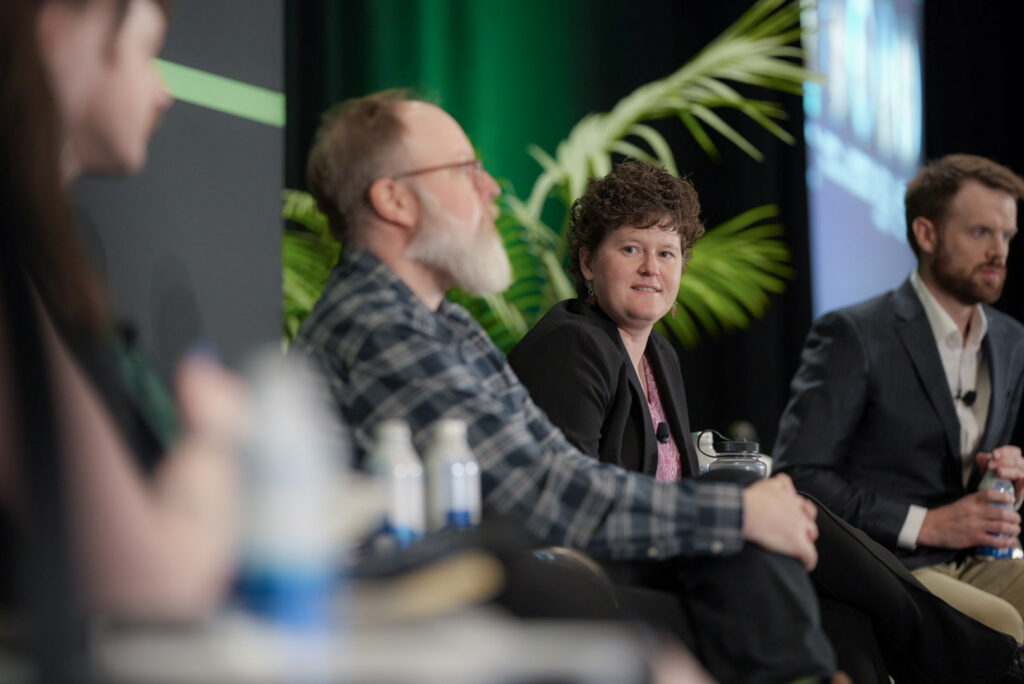
A Case Study Discussion: Reflections on Corporate and Project-specific Successes from Industry Representatives
Panel session moderated by Michael Van Laeken
Renewable energy companies are increasingly moving beyond simply offsetting impacts to maximizing ecological benefits within project footprints. This panel session brought together industry leaders to share lessons learned and practical strategies for aligning conservation goals with project delivery.
Key Takeaways:
- Panelists from Apex Clean Energy, Avangrid, and EDP Renewables shared recognized corporate and project-level wins
- Discussion focused on conservation and biodiversity goals—including net-positive impact—that are practical, actionable, and reportable
- Collaborative approaches are driving measurable ecological outcomes alongside clean energy generation
- Topics included cost-effective solutions that meet evolving corporate and ESG expectations
- Highlighted the value of cross-industry knowledge-sharing in advancing responsible renewable energy development

Optimized Smart Curtailment™ (OSC™) for Bats: Testing Efficacy with Multiple Data Streams at Wind Energy Facilities
Poster presented by Michael True, prepared by Amanda Hale
Wind turbine bat mortality remains a key conservation challenge as wind energy continues to expand to meet growing demands for electricity and decarbonization goals. WEST’s OSC system offers a data-driven alternative to traditional blanket curtailment—reducing bat risk while protecting power production.
Key Takeaways:
- OSC uses a Bayesian decision-tree framework to curtail turbines when bat risk is highest and energy production potential is lowest
- 2024 and 2025 field testing results showed turbines under OSC produced more power than those under blanket curtailment, while achieving equivalent reductions in bat risk
- Multiple data streams validated results: ground and nacelle acoustic detectors, thermal videography, post-construction fatality monitoring, and power production data
- OSC represents a practical, regulatory-accepted approach to balancing bat conservation, energy output, and evolving compliance expectations
View the complete poster here.

Navigating the Shift: Practical Conservation Strategies for Renewable Energy Projects in a Changing Regulatory Landscape
Panel session co-led by Todd Mattson
Shifting federal and state conservation policies are creating real uncertainty for renewable energy developers. This panel discussion examined how proactive, science-based conservation strategies can reduce species risk and support project viability across wind and solar portfolios.
Key Takeaways:
- Treat compliance as an early-stage development decision. Risk is locked in, or avoided, based on siting and permitting choices made at the start, not later.
- Bring technical and legal advisors in earlier. Early risk assessment now means actively designing projects to avoid regulatory exposure, not just identifying constraints.
- Treat permitting strategy as business strategy. Be intentional about agency engagement timing, permit sequencing, and whether state or local pathways can offset federal uncertainty.
- Know why you’re deploying avoidance and mitigation measures. Is the driver regulatory risk, financing expectations, or both? The legal implications differ.
- Get ahead of the financing conversation. Pair transparency about regulatory uncertainty with a defined strategy; complexity should build confidence, not hesitation.

What’s New and What’s Next in Conservation Planning for Bats Affected by Wind
Presented by Victoria Zero
With shifting government policies creating new risks and uncertainties, innovative bat conservation strategies in wind energy have never been more important. This session highlighted advances in wind-bat habitat conservation plans (HCPs) and compliance approaches WEST has developed and implemented with US Fish and Wildlife Service (USFWS) approval.
Key Takeaways:
- Showcased two wind projects meeting fatality targets while delivering meaningful conservation value through smart curtailment
- Highlighted OSC implementation, acoustic-activated curtailment, and fleet-scale monitoring and mitigation
- Discussed what works in both permitted (HCP/ITP) and non-permitted (avoidance or managed risk) scenarios
- WEST’s approaches have been developed and implemented with USFWS approval
- Demonstrated WEST’s leadership role in advancing practical, innovative compliance solutions for long-term project viability
These presentations reflect WEST’s industry leadership and ongoing commitment to advancing practical, defensible conservation solutions that support both renewable energy development and natural resource protection. As regulatory frameworks continue to evolve, the need for innovative monitoring methods, adaptive mitigation strategies, and collaborative planning has never been greater. The ACP Siting and Permitting Conference provided an important forum to share lessons learned, test new ideas, and highlight successes across the industry. We look forward to continuing these conversations and partnering with developers, agencies, and stakeholders to support smart, sustainable energy projects. If you’d like to learn more about this work or explore how these approaches could support your project, connect with the WEST team.