
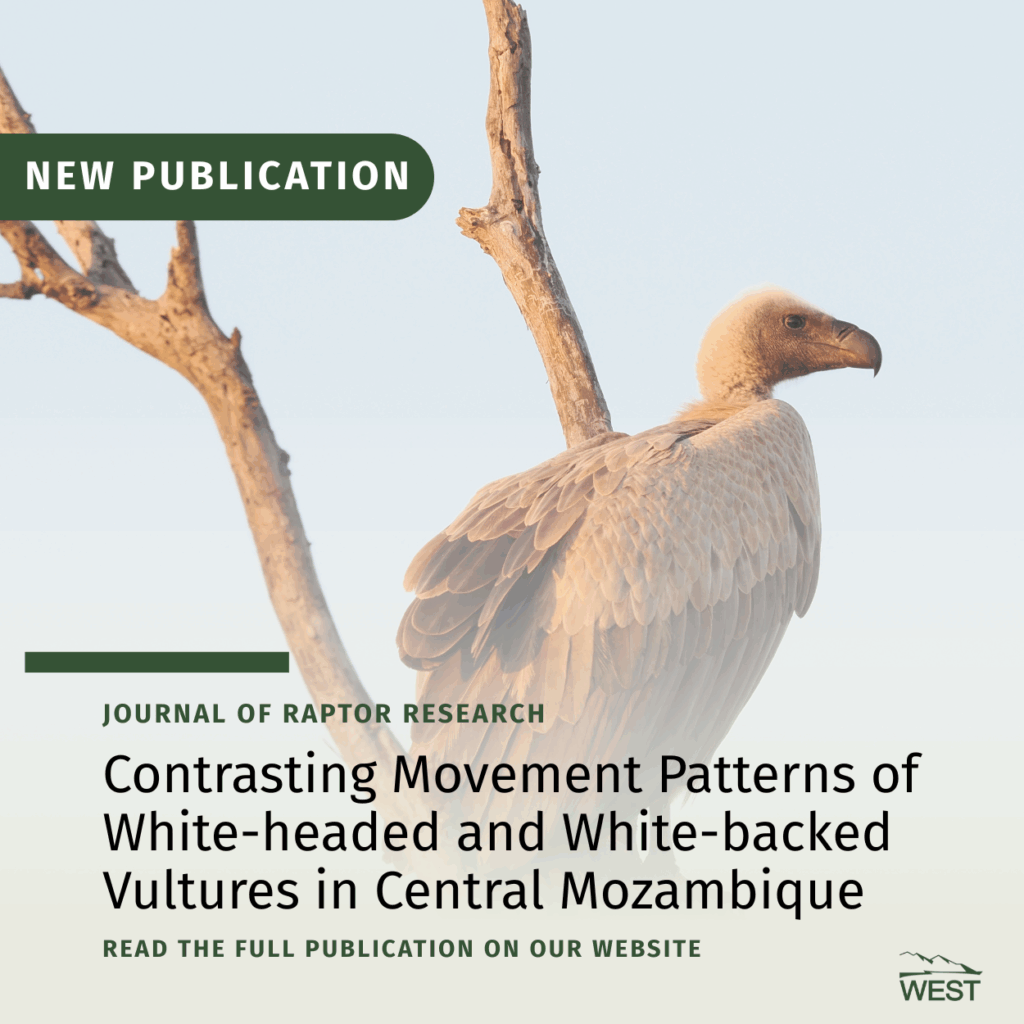
WEST biologist Eric Hallingstad is a co-author of the recently published research article, “Contrasting Movement Patterns of White-headed and White-backed Vultures in Central Mozambique,” featured in the Journal of Raptor Research.
This study utilized satellite telemetry to evaluate movement ecology and niche partitioning between two critically endangered vulture species—white-headed vulture and white-backed vulture—in and around Gorongosa National Park, Mozambique. Key findings include:
- White-headed vultures exhibited lower average flight altitudes and slower flight speeds compared to white-backed vultures.
- White-headed vultures initiated flight activity earlier in the day and maintained higher activity levels throughout daylight hours.
- These behavioral differences are likely driven by morphological traits (notably lower wing loading in white-headed vultures), enabling them to exploit weaker thermals and search more efficiently for smaller carcasses or prey.
- In contrast, white-backed vultures rely on higher, faster flight and social information transfer to locate larger, more dispersed food resources.
The results underscore the importance of movement-based niche partitioning in facilitating coexistence and have direct implications for conservation strategies, especially as both species face rapid population declines.
Read the full publication here.