The Wildlife Society (TWS) Annual Conference took place this year, from November 1–5, in Des Moines, Iowa. The conference is one of the largest gatherings of wildlife professionals and supporters in North America, and it has spotlighted advancements in wildlife management and research for over 30 years, with sessions spanning the breadth of wildlife science and conservation.
WEST was proud to exhibit and present a poster reflecting our applied research on wind energy and birds. We spent the week learning from and presenting in sessions on bat monitoring, wildlife movement, sensitive species, and more. Our team also moderated two sessions on endangered species and caught up with partners and colleagues from state and local agencies, universities, and industry.
Key Conference Takeaways
During the conference, several themes stood out for anyone designing, conducting, or relying on wildlife monitoring.
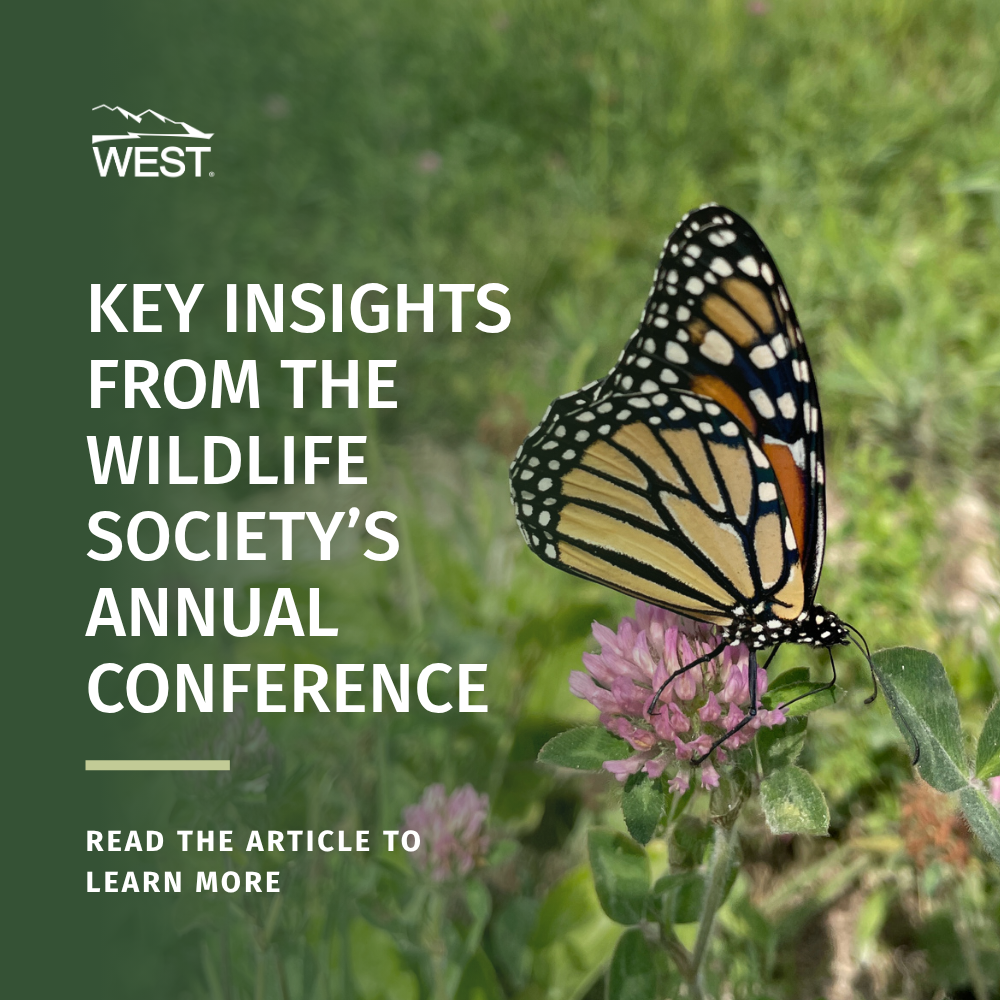
- Better monitoring starts with greater detail. A monitoring workshop on the monarch butterfly showed that the level of detail collected can shape the value of the resulting data. For sensitive species like the monarch butterfly and bumble bees, small additions to monitoring efforts may produce higher-quality and more accessible reporting for partners and stakeholders.
- Technology is expanding what bat surveys can do. In one study, researchers paired radio telemetry with thermal-camera drones to locate bats in inaccessible or heavily wooded areas. In another study, researchers used acoustic detector arrays to determine the direction that bats travel. Combined with feeding-buzz acoustic data, this can help separate commuting from foraging.
- Bats turn up in unexpected places. An Illinois study found numerous long-eared bats roosting in park trees in a sparsely vegetated urban area, a reminder to look closely at potential habitat, even where tree cover is limited.
- Targeted approaches can outperform broad ones. In a Texas horned lizard study, treating fire-ant mounds selectively and for short periods of time reduced fire ants and increased survival of horned lizard hatchlings, though the method appears best suited to relatively small areas or areas of concentrated fire-ant mounds.
- Wildlife movement through managed landscapes remains a priority. Sessions on wildlife crossings addressed corridors, fencing, and how animals move through managed landscapes, which are themes that may inform conservation strategies in the western US.
- Data are only as strong as the reporting behind them. From monarch butterfly monitoring to banded bird fatality records, the value of a dataset depends on what data is collected and how consistently it is reported.
WEST Poster Session

Geographic Origins of Banded Bird Fatalities Encountered at Wind Energy Facilities
We shared how banding and encounter data can help reveal where birds found as fatalities at wind energy facilities originated, which is an open question for understanding impacts on bird populations at local, regional, and continental scales.
Key Takeaways
- Banding and encounter data can supplement stable isotope analyses with more precise banding locations, recorded age and sex, and known natal locations for birds banded as flightless chicks.
- Records from the US Geological Survey Bird Banding Laboratory (as of December 31, 2024) include 77 “struck wind turbine” encounters across 27 species. Over half (43) of the encounters were too young to fly when banded, and 29 of these 43 birds that were banded as chicks (67%) were found as fatalities at wind turbines less than 50 miles from their banding location.
- The dataset remains relatively small as fatalities are often found by personnel who may not know to check for bands or how to report bands if noticed. Training contractors and facility staff to check carcasses and use the “struck wind turbine” code, rather than “found dead,” would strengthen our understanding of wind energy impacts on birds.
Advancing Wildlife Science Together
The takeaways above are a snapshot of what we learned and shared in Des Moines. From banded bird data that sheds light on bird fatalities to emerging tools for monitoring bats and sensitive species, our team is helping projects move forward responsibly while also supporting the species and their habitats.
If any of these topics resonate with your projects, reach out to learn how WEST can be a valued resource.