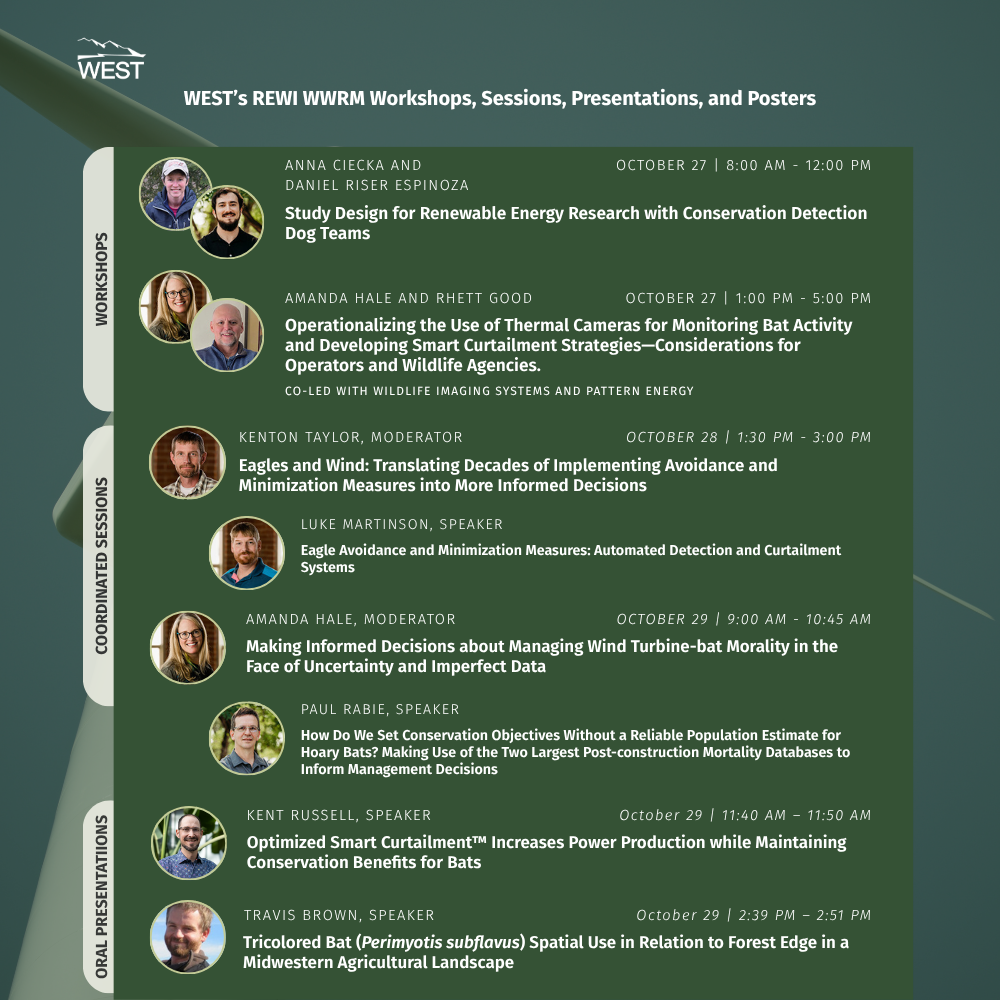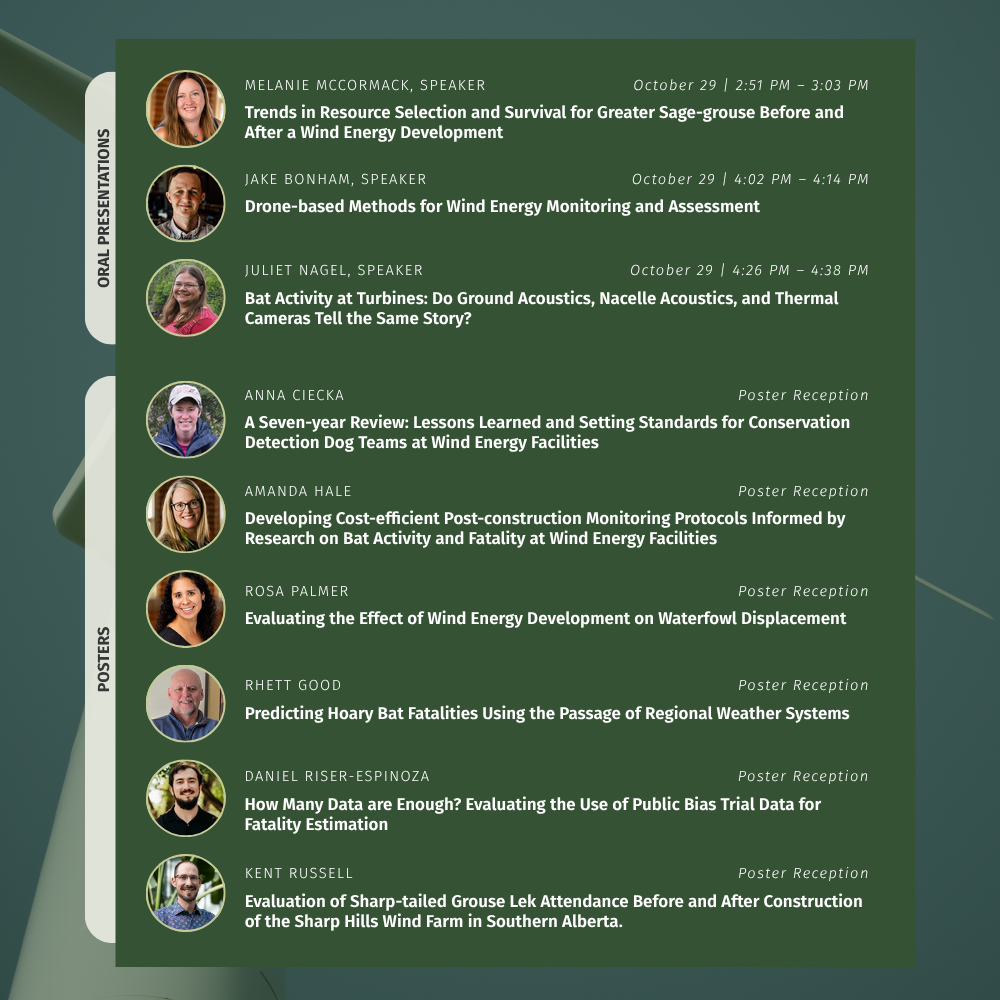
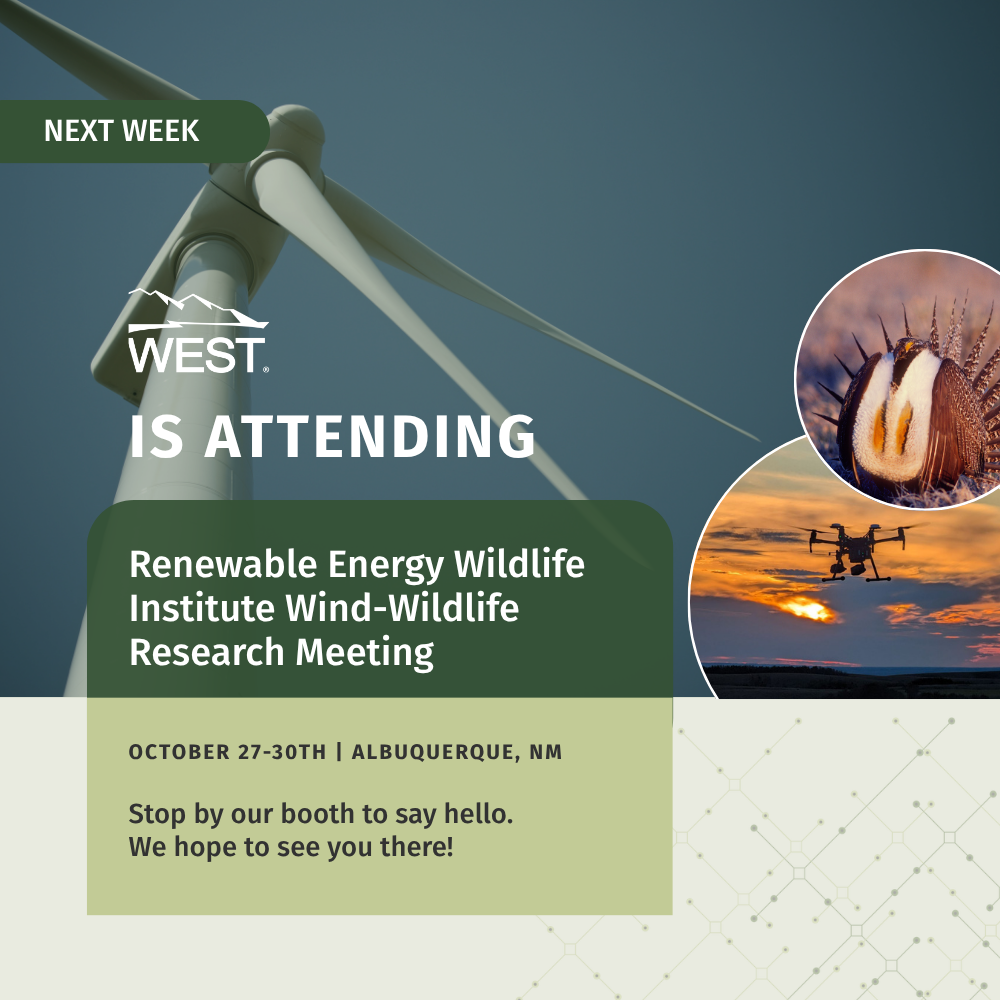
Next week, WEST is heading to Albuquerque for the REWI’s 16th Wind Wildlife Research Meeting, October 27–30, and we’re proud to be a Gold Sponsor. Fourteen of our staff will be on site sharing research on bats, birds, and the monitoring tools that help projects make better decisions.
We kick things off Tuesday, October 27, with two pre-meeting workshops. The morning session covers study design with conservation detection-dog teams, and the afternoon session covers operationalizing thermal cameras for bat monitoring and smart curtailment.
Amanda Hale and Rhett Good are leading a coordinated session on managing turbine-related bat mortality when data are uncertain and imperfect. The session features Paul Rabie’s work on setting hoary bat conservation objectives without a reliable population estimate. Kent Russell will share how Optimized Smart Curtailment™ increases power production while maintaining conservation benefits for bats. Juliet Nagel asks whether ground acoustics, nacelle acoustics, and thermal cameras tell the same story, and Travis Brown presents tricolored bat use of forest edges in a midwestern agricultural landscape.
Kenton Taylor and Luke Martinson are leading a coordinated session that translates a decade of eagle avoidance and minimization science into better decisions. Melanie McCormack presents trends in greater sage-grouse resource selection and survival before and after wind development. Jake Bonham will cover drone-based methods for wind energy monitoring, and Rosa Palmer’s on-demand talk looks at scaling renewable energy in developing countries.
Our team will also present six posters at the poster reception. Topics include detection-dog team standards, cost-efficient post-construction monitoring, fatality estimation, hoary bat fatality prediction, waterfowl displacement, and grouse lek attendance.
Stop by WEST’s booth to connect with our experts throughout the week!