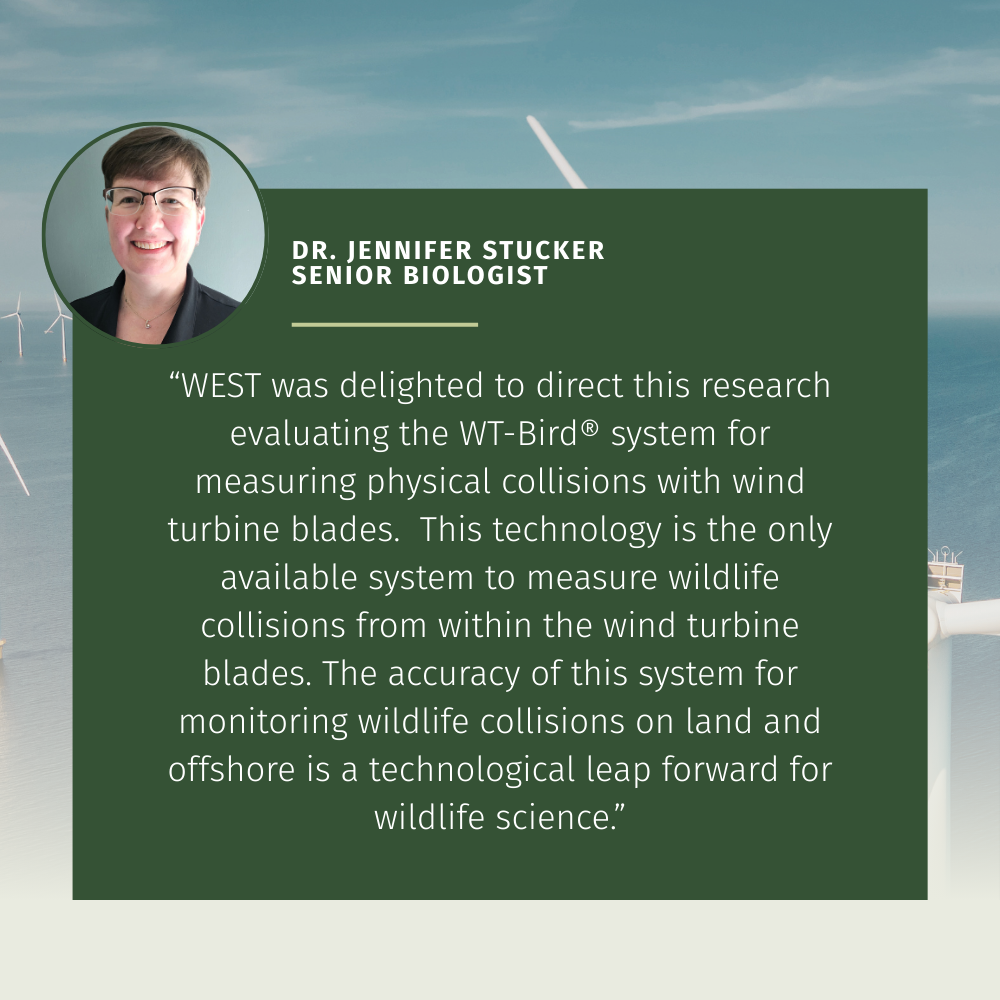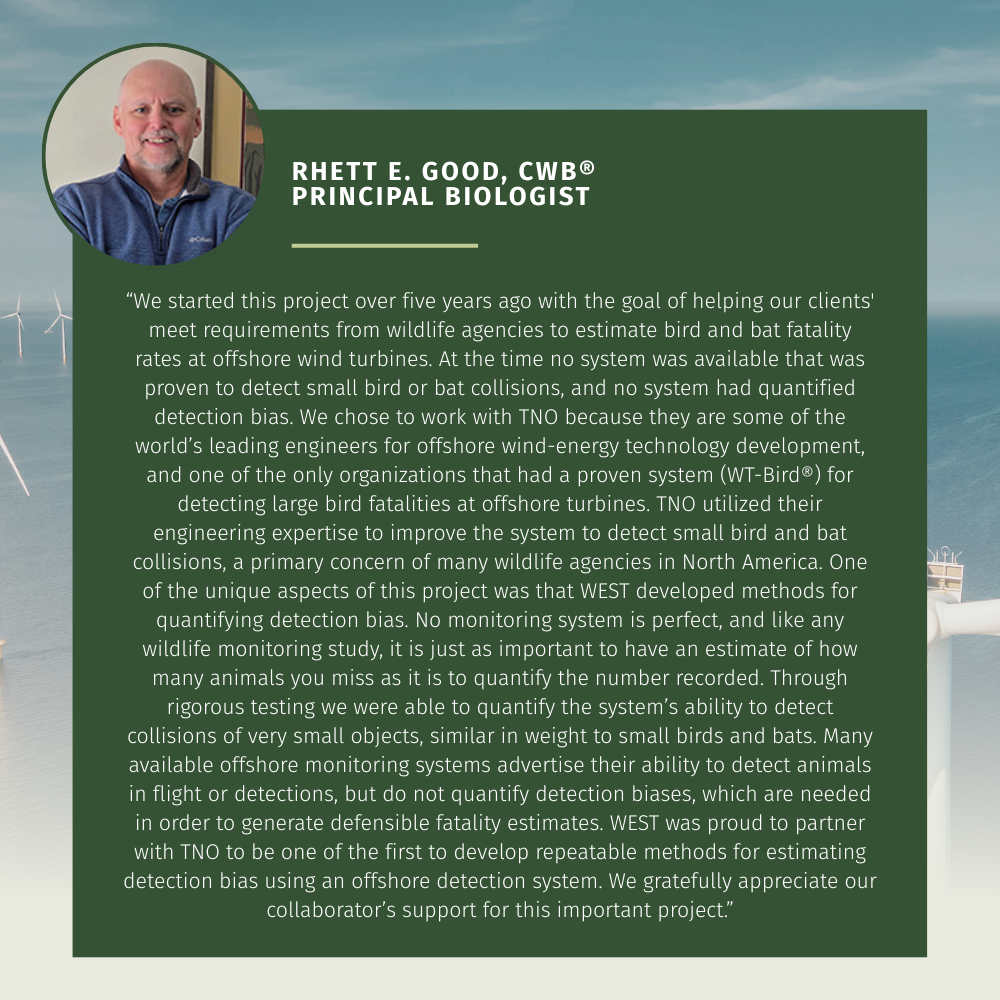
WEST is proud to announce the release of the Final Technical Report, “A Multi-Sensor Approach for Measuring Bird and Bat Collisions with Offshore Wind Turbines.”
This multi-year research effort—conducted in collaboration with the Netherlands Organisation for Applied Scientific Research (TNO) and with support from the University of Minnesota’s St. Anthony Falls Laboratory—focused on advancing collision monitoring technology to better understand bird and bat interactions with offshore wind energy facilities.
Through key innovations in vibration sensing, imaging systems, and machine learning algorithms, the updated WT-Bird® system demonstrated improved detection of both small birds and bats, during day and night, marking a major step forward in quantifying wildlife interactions with wind energy infrastructure.
Field validation demonstrated that the enhanced WT-Bird® system could detect collisions as small as eight grams and deliver statistically comparable results to traditional post-construction collision and fatality surveys. Additional innovations in edge image processing reduced data storage needs by over 90%, marking a significant step toward scalable, long-term monitoring at offshore turbines.