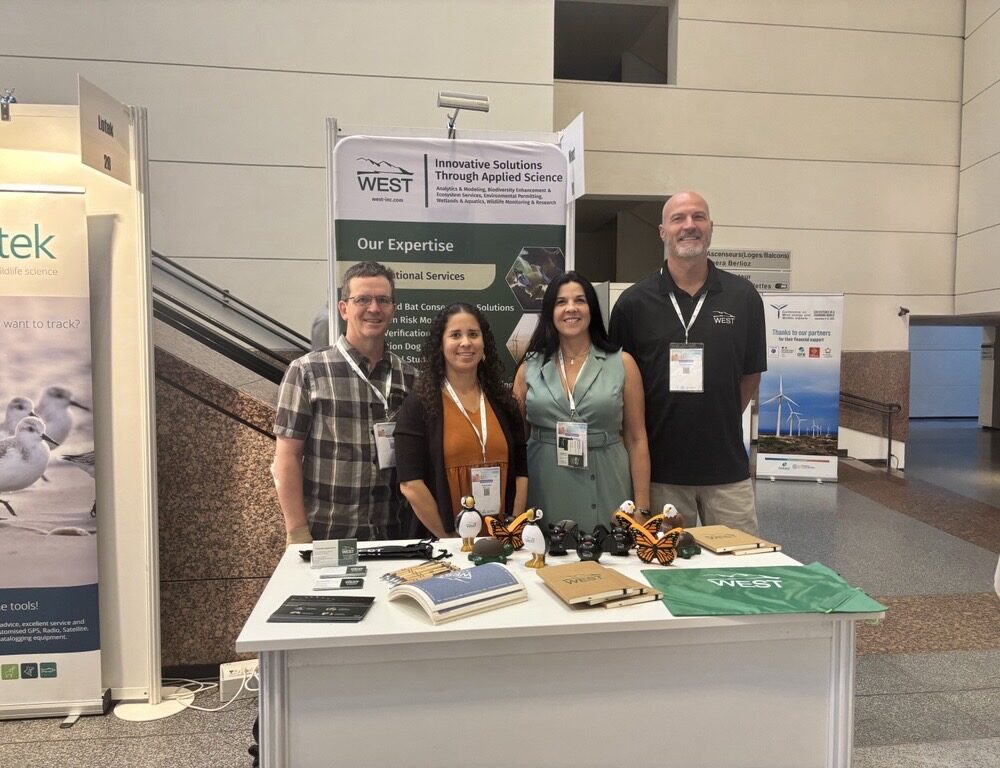
Last month, WEST experts presented at the 8th Conference on Wind energy and Wildlife impacts – CWW2025 in France, a global forum where industry leaders, researchers, conservationists, and policy makers come together to shape the future of sustainable energy. Our team shared cutting-edge strategies and research designed to balance renewable energy development with wildlife protection.
Here’s a detailed recap of our sessions:
Strategies for Efficient Large Bird Fatality Monitoring
Presented by Eric Hallingstad
Eric’s session focused on the Post-construction Fatality Monitoring (PCFM) Handbook and Decision Support Tool, released in 2023, which provides a global framework for designing consistent and systematic monitoring programs. He discussed the critical role PCFM plays in understanding the direct impacts of wind energy facilities on wildlife and enabling stakeholders to take informed actions to avoid, minimize, and mitigate these impacts.
The presentation explored the challenges of monitoring in diverse environments, such as rugged terrain, dense vegetation, and agricultural landscapes where achieving adequate detection probabilities can be costly and complex. Eric shared WEST’s research comparing standardized search methods with innovative approaches like passive detection by operations staff and drone-based searches, which can improve efficiency without sacrificing accuracy. He also emphasized the importance of using the best available surrogates in persistence trials and highlighted lessons learned in the US that can be applied globally to help operators meet compliance requirements while optimizing resources.
Wind in the Tropics
Presented by Kate MacEwan and Rosa Palmer
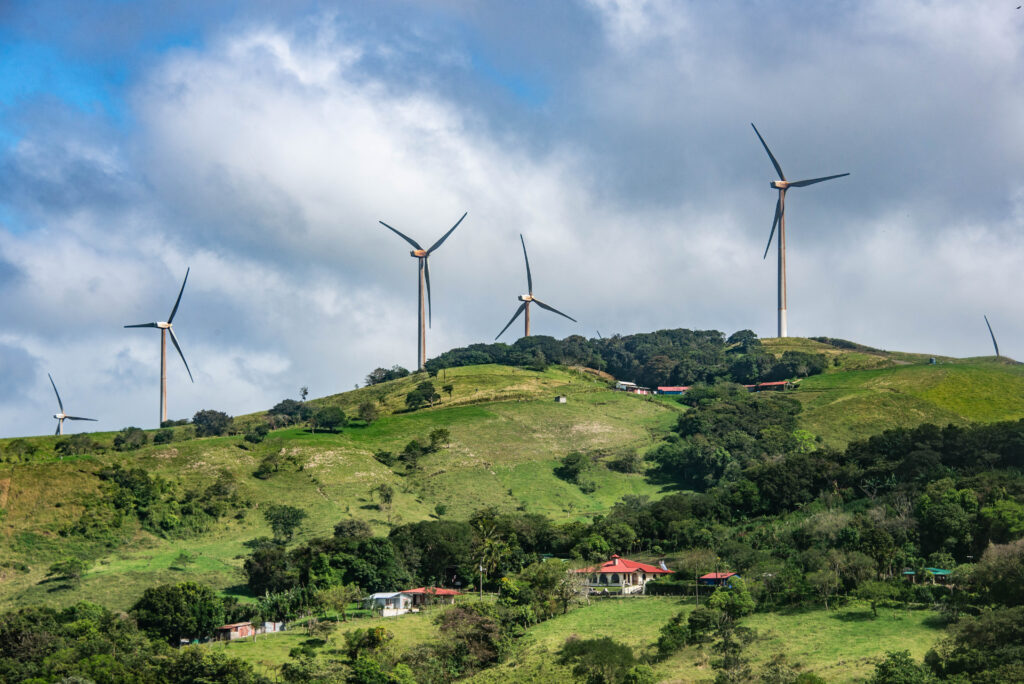
Kate and Rosa, together with Emma Bennett (Elmoby Ecology) and Stephanie Sioson (Asian Development Bank), led a powerful discussion on the unique challenges and opportunities of wind energy development in tropical regions, areas that are both biodiversity hotspots and economically underdeveloped. The session brought together diverse voices across Tropical Asia, the Afrotropics, and the Neotropics to address barriers such as financial constraints, political complexities, and language differences that often limit participation from these regions.
They highlighted the rapid economic growth in the tropics over the past three decades and the corresponding rise in renewable energy projects. However, these developments often intersect with habitats rich in endemic species, creating complex conservation challenges. Kate and Rosa stressed the importance of integrating local communities and cultural perspectives into project planning to ensure sustainable, long-term solutions that support both energy goals and biodiversity conservation.
Watch Kate and Rosa’s video interviews with local people working in the Afrotropics and the Neotropics.
Rapid Build-out of Wind and Solar Energy May Reduce Global Extinction Rates
Presented by Paul Rabie
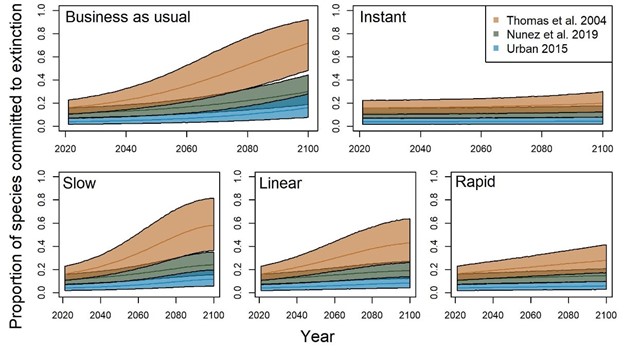
Paul presented work from a manuscript that he submitted with WEST co-authors John Lloyd, Everett Abhainn, Ph.D., Julie Bushey, and Angela Hsiung, as well as Renewable Energy Wildlife Institute co-author Taber Allison. Paul’s presentation explored how the pace of transition away from fossil fuels impacts the scale of global climate-driven extinction risk.
This important work emphasizes the need to move rapidly to deploy renewable energy because the risk from climate-related impacts to biodiversity—if we do not move away from fossil fuels—is substantial. Paul emphasized that direct impacts from renewable energy development still require mitigation but urged practitioners to consider the climate-driven extinction risk when weighing the direct impacts of renewable energy deployment.
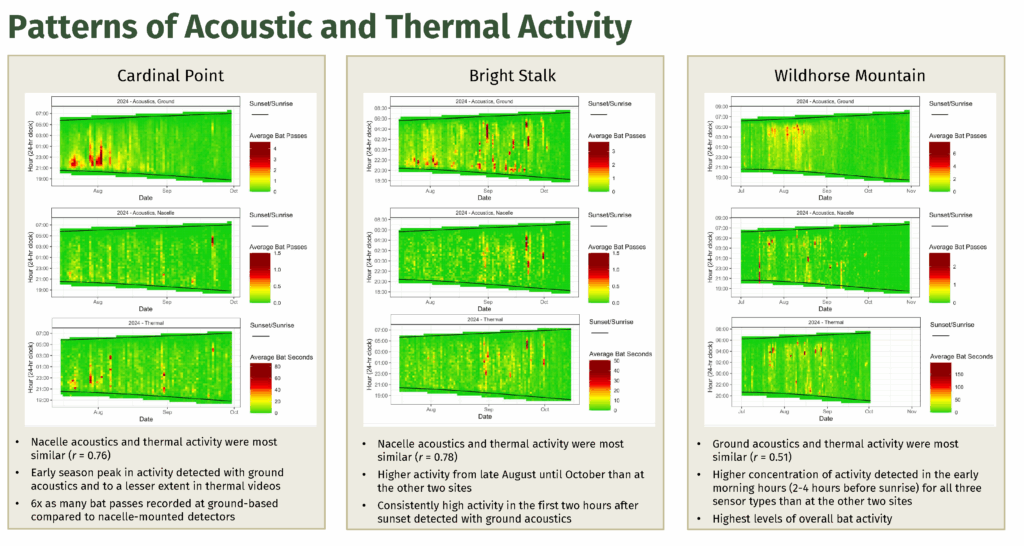
Smart Curtailment for Bats: Testing Efficacy with Multiple Data Streams at Three Wind Energy Facilities
Presented by Paul Rabie
Paul’s poster presentation addressed one of the most pressing conservation challenges in wind energy: bat mortality. Bats have low reproductive rates and rely on high adult survival, making them particularly vulnerable to turbine-related fatalities. With global demand for wind energy accelerating to meet decarbonization goals, Paul emphasized the need for cost-effective, practical strategies to minimize these impacts.
He introduced Optimized Smart Curtailment™ (OSC™), a WEST-developed approach that uses Bayesian decision tree models to identify high-risk periods for bats and low energy production windows. Unlike traditional blanket curtailment, which can result in significant energy loss, OSC enables targeted turbine shutdowns, reducing bat fatalities while maintaining energy production. This approach demonstrates how data-driven solutions can balance wildlife conservation with renewable energy production.
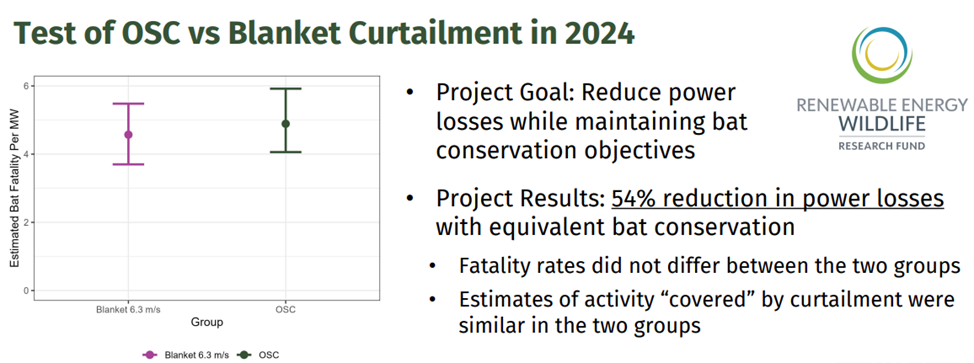
You can view Paul’s complete poster here.
Our work at CWW reflects our commitment to developing science-based, practical solutions that help clients achieve compliance, reduce environmental impacts, and meet global sustainability goals.
We remain dedicated to international conservation efforts and minimizing environmental impacts worldwide. We’re excited to continue these conversations at Windaba in South Africa from October 21-23, 2025 – see you there!